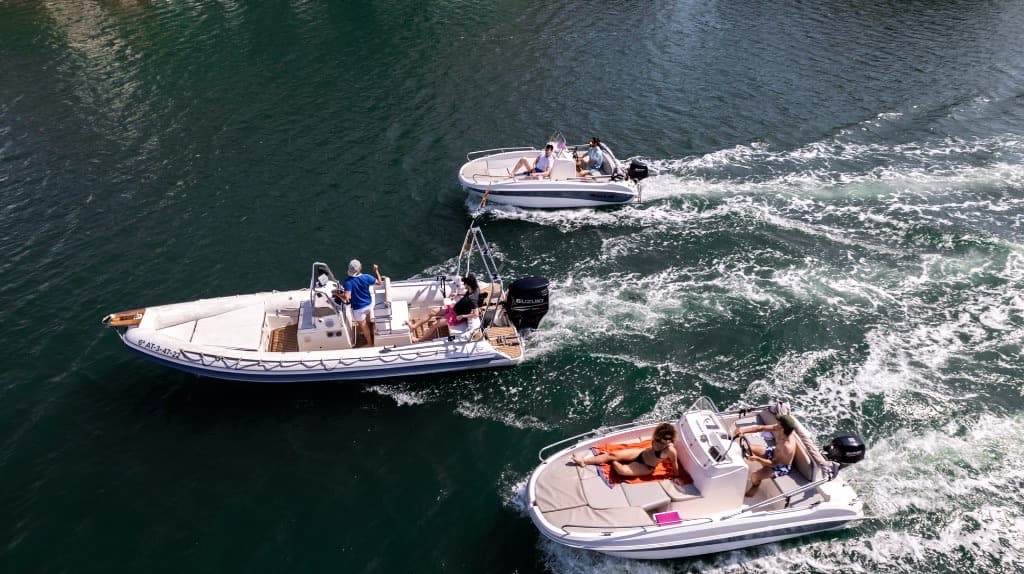
Every season, dozens of people arrive in Roses with the same idea: rent a boat and explore the coast. And every season, many of them hesitate at the last moment. Will it be hard? Do I need some kind of licence? What happens if I get lost or something goes wrong?
This guide exists to answer those questions honestly. Without overstating how easy it is or glossing over what you need to know. After reading it, you'll have all the information to decide whether a no-licence boat is the right choice for you — and if so, how to make the most of it from day one.
Do you need a licence to rent a boat in Roses?
The short answer is no. In Spain, nautical regulations allow you to rent vessels up to 5 metres in length with engines up to 15 HP without any qualification. No nautical school, no card, no prior paperwork. The only condition is that the person at the helm must be over 18.
Passengers can be any age — in fact, families with young children are one of the groups that enjoy this type of outing most, especially in calm environments like the Santa Margarita canals.
This regulation is specific to Spain. If you're from a country with stricter rules, it may surprise you — but it's completely legal and standard practice along the entire Spanish Mediterranean coast.
Is it hard to handle a no-licence boat?
It depends what you mean by hard. Compared to driving a car in a city, handling a no-licence boat through the Santa Margarita canals is considerably easier. No traffic lights, no pedestrians stepping out and the maximum speed in the inner canals is very low.
No-licence boats have low-power engines that respond gently and predictably. They don't accelerate suddenly, have no clutch and the steering is intuitive. Most people get the hang of it within the first 10–15 minutes of canal navigation.
What does require some attention is mooring and manoeuvring in the narrowest stretches of the inner canals, where you need to keep a steady, low speed. These moments call for concentration, but with the instructions from the pre-departure briefing and by going slowly, they pose no real problem.
The key is not to rush. A no-licence boat is not a vehicle for going fast — it's a vehicle for enjoying things slowly.
The Santa Margarita canals — the best place to start
Not all environments are equal for a first outing. Setting off directly into open sea with waves and heavy nautical traffic can be overwhelming for someone without experience. The Santa Margarita canals are exactly the opposite.
The Santa Margarita inland waterways are completely sheltered: no swell, no currents and low speed limits. It's the ideal environment to gain confidence with the boat before venturing into the Bay of Roses.
But what's most interesting is that the canals aren't just a practice ground — they're a destination in their own right. On both sides of the waterways, hundreds of homes have direct water access from their gardens. Each with its own private pontoon, terrace overlooking the canal and small boat tied up alongside. It's an image you don't expect to find on the Costa Brava and one that stays with you.
By the time you reach the Bay of Roses after navigating the canals, you've already been on the water 30–40 minutes and handling the boat is no longer a worry. You can focus on enjoying the view.
What happens on the day
So there are no surprises, here is what happens from the moment you arrive to when you return.
Before you set off — the briefing
We meet you at the Santa Margarita Marina at the agreed time. One of our skippers — Salvador or the team — welcomes you and spends 10–15 minutes explaining how the boat works: how to start it, accelerate, steer, stop and manoeuvre in the canals. We also orient you with a map of the area and recommend a route based on available time and sea conditions.
It's not a lecture. It's a practical conversation in front of the boat. If you have questions, that's the time to ask them.
The first minutes in the canals
The first part of the trip always takes place in the inner canals. It's the moment to get familiar with the boat without pressure: low speed, calm waters and a landscape that holds your attention. Most people leave the canals feeling it was easier than expected.
The Bay of Roses and beyond
Once in the bay, the world opens up. You can stay close and anchor in a cove, or venture towards the coves of Cap de Creus if conditions allow. You decide the pace and the route — there's no obligation to go anywhere in particular.
The return
You return to the marina at the agreed time according to the option you booked. If any question or incident arises during the trip, you have our phone number available at all times.
The 6 questions first-timers ask us most
What if I get lost?
The Santa Margarita canals are a very recognisable, relatively small environment. Getting lost is unlikely. Before you set off, we orient you with a map and you have our phone number for any questions during the trip. The Bay of Roses also has very clear visual landmarks — the village of Roses and the Pyrenees in the background are visible from anywhere in the bay.
What if I bump into something?
Minor scrapes are a normal part of canal navigation, especially on first outings. The boats have side fenders specifically for this reason. For more serious incidents, there is coverage included — check the exact terms when booking. The important thing is to go slowly and without rushing, which is exactly what the canals encourage.
Can I go alone, without any passengers?
Yes. Our no-licence boats are perfectly manageable by a single person. In fact, some of the most peaceful and enjoyable departures we have are solo early-morning trips to explore the canals.
Do I need to be able to swim?
It's not compulsory, but recommended if you plan to swim in the coves. Life jackets are included in the rental and we recommend wearing them, especially if there are children on board.
Can we bring food and drinks?
Yes, absolutely. In fact, we recommend it for full-day trips. A cool box with cold drinks, some snacks and the shade of the boat make lunchtime in a cove one of the best moments of the day.
What if the weather turns bad during the trip?
If the forecast is poor before you set off, we notify you in advance and cancel at no cost. If conditions deteriorate during the trip, the recommendation is always to return to port. The Santa Margarita canals are a natural refuge — in case of wind or rain, the inland waters remain navigable and safe.
What to bring on the day
Basic checklist for a first no-licence outing from Roses:
- High-factor sunscreen — the sun's reflection off the water multiplies exposure
- Polarised sunglasses
- Swimwear and a towel if you plan to swim
- Footwear with non-slip soles — never flat flip-flops without grip
- Cool box with water and cold drinks, especially in July and August
- Phone in a waterproof case or dry bag
- A light layer for the return trip if you're heading out at sunset — it gets cooler on the water than you'd expect
Shoulder season vs. peak season — when to go
This question deserves an honest answer. July and August in Roses are spectacular months but also the busiest. Coves get more crowded, nautical traffic in the bay is heavier and boat availability sells out weeks in advance.
If you have flexibility, May, June and September offer excellent sailing conditions with far less crowding. The water is perfect for swimming, the coves are peaceful and the Santa Margarita canal experience has an entirely different quality when you're not sharing the space with dozens of other boats.
For families with young children, June is probably the ideal month: water already warm, long days and none of the August crowds.
What if you'd rather someone else take the wheel?
If after reading this you decide you'd prefer to enjoy the day without worrying about navigation, we have that option too. Our private skippered excursions combine a journey through the Santa Margarita canals with a trip to Cap de Creus and the most spectacular coves on the northern Costa Brava. Salvador or the team take care of everything — you just focus on enjoying the ride.
Private skippered excursions
Cap de Creus, wild coves and canals. The skipper handles the route.